


Why Spot Welding Quality Matters in Replacement Battery Manufacturing
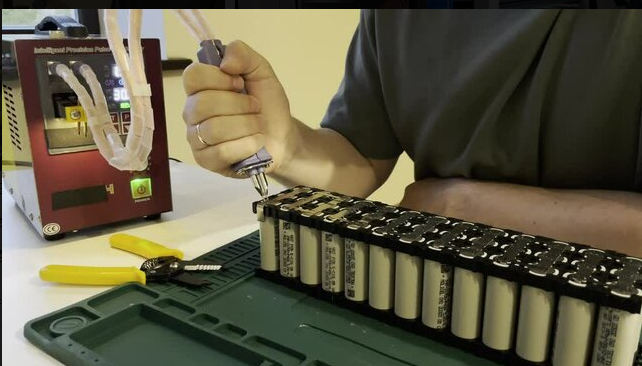
When people compare replacement batteries, they usually look at voltage, capacity, dimensions, and price.
Few buyers think about how the cells inside the battery pack are connected.
But for a professional battery manufacturer, the connection between cells and the battery terminals is an important part of the production process.
One commonly used method is resistance spot welding.
A good welding process helps create a battery pack with reliable electrical connections and consistent mechanical strength. Poor welding, on the other hand, can create problems that may not be visible from the outside.
What Is Spot Welding in Battery Manufacturing?
Spot welding is a process used to connect battery cells with nickel strips or other suitable conductive materials.
Instead of applying heat across the entire battery, controlled electrical current creates localized heat at the welding points.
This allows the connection to be made quickly while limiting the amount of heat transferred to the cell.
For lithium battery pack manufacturing, controlling this process is important because excessive heat can affect cell performance.
Why Welding Consistency Matters
A battery pack may contain multiple cells and electrical connections.
Every connection needs to meet the required production standard.
Inconsistent welding can lead to differences in:
- Connection strength
- Electrical resistance
- Current transmission
- Mechanical stability
These differences may not be obvious during a basic visual inspection.
This is why professional battery manufacturing requires both process control and inspection.
Visual Inspection Is Only the First Step
After welding, operators can check the battery pack for visible problems such as:
- Uneven welding points
- Damaged nickel strips
- Poor positioning
- Surface deformation
- Inconsistent assembly
However, appearance alone does not tell the whole story.
Depending on the battery design, manufacturers may also use electrical and mechanical checks to verify that the connection meets the required specifications.
Avoiding Excessive Heat During Welding
Lithium cells are sensitive to excessive heat.
During spot welding, parameters such as welding current, pulse duration, electrode pressure, and welding position need to be controlled according to the battery design and materials being used.
The objective is simple:
Create a reliable connection without unnecessarily exposing the cell to excessive heat.
This is one reason why battery assembly should not be treated as a simple process of connecting cells together.
Consistent Welding Helps With Batch Quality
For a distributor or repair company, receiving one good battery is not enough.
They need the next shipment to perform in the same way.
This makes manufacturing consistency particularly important for B2B battery supply.
A controlled welding process helps manufacturers maintain repeatability across production batches and reduce variations caused by manual assembly.
Why This Matters for Barcode Scanner and POS Batteries
Replacement batteries for barcode scanners, POS terminals, PDAs, and mobile computers are often compact.
There is limited space inside the battery housing, which means the internal structure needs to be carefully designed.
The battery pack must balance:
- Cell arrangement
- Electrical connections
- Protection circuit
- Insulation
- Housing dimensions
- Mechanical stability
A small battery still requires a complete manufacturing process behind it.
Quality Is Built Into the Process
Battery quality cannot be created by final inspection alone.
It starts with material selection and continues through every stage of production:
Cell selection → Cell matching → Welding → PCB/PCM assembly → Insulation → Housing → Testing → Final inspection
Each step has an effect on the finished battery.
This is why experienced battery manufacturers pay attention to production details that customers may never see.
What Should Buyers Ask Their Battery Manufacturer?
When evaluating a replacement battery supplier, it is useful to understand how the battery is manufactured.
Instead of asking only about capacity and price, buyers can also ask:
- How are cells connected?
- How is the welding process controlled?
- What inspections are performed after assembly?
- How is batch consistency maintained?
- What testing is completed before shipment?
These questions provide a better understanding of the manufacturer’s production capabilities.
Conclusion
A replacement battery is more than a cell, a PCB, and a plastic housing.
The quality of the finished product depends on how these components are selected, assembled, connected, and tested.
Spot welding is only one step in the manufacturing process, but it demonstrates an important principle:
Small production details can have a significant impact on overall battery quality.
For professional applications such as barcode scanners, POS terminals, PDA devices, and mobile computers, consistent manufacturing is essential.
At Leyoch, we focus on the details behind the finished product—not only the specifications printed on the label.
About Leyoch
Leyoch develops and manufactures replacement batteries for barcode scanners, POS terminals, PDA devices, mobile computers, and other professional equipment.
Our manufacturing process covers cell selection, battery pack assembly, protection circuit integration, welding, finishing, testing, and quality inspection.
We work with distributors, repair companies, OEM partners, and equipment service providers looking for consistent battery solutions and long-term supply support.
Learn more about our battery solutions and manufacturing capabilities at: